

Cultivated Meat from the Farm
RespectFarms' concept is unique by combining the best of biotechnology and agriculture.
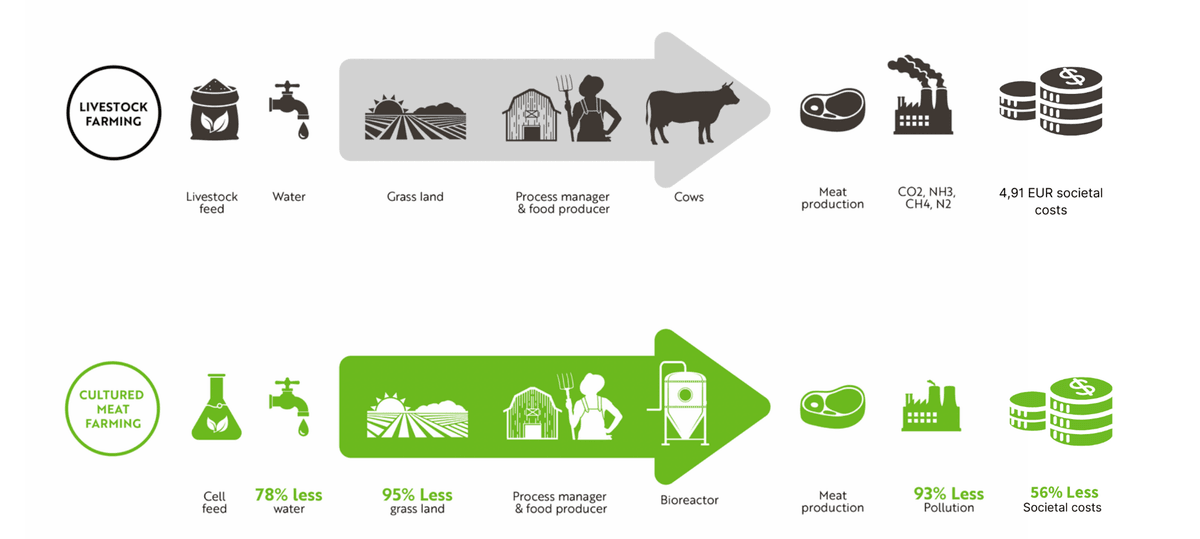
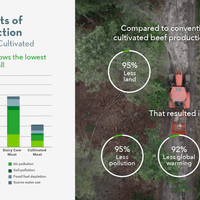
As system integrator, we repurpose infrastructure, reuse what is useful, and provide an earning model for the food producers of our future. With that, we need up to 78% less water, 95% less land, 93% less pollution and create 56% less societal costs compared to conventional meat production.
The Future of Farming
We believe that farmers can create value and earn money
with cellular agriculture. Our research showed that it is feasible, viable, and desirable.
For a potential business case
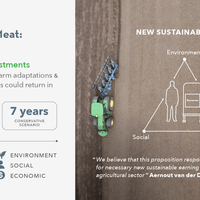
Farmers are interested
An attractive business model
For a better future
Learn more
Our history roots back to the Godfather of this industry. Since 2021 our team is dedicated to researching farm-scale cultured meat and how we can develop a business model for farmers. Learn more about the details of our research results in our blog articles.
FAQs
To what extent is cultivated meat more sustainable than conventional meat?
Research by CE Delft –the first ever based on data from cultured meat companies – shows that growing meat from cells can reduce the climate impact of meat production by up to 92%. This compares to anambitious scenario for conventional livestock farming in 2030 – where farmers manage to reduce the carbon footprint of meat by 15% (beef), 26% (pork) and 53% (chicken). Compared to the current average environmental impact, the benefits of meat directly grown from cells are even greater. And if we return the freed land to nature or use it for carbon sequestration, the positive climate impacts could be even greater.
What is the advantage of our farm-scale concept?
Producing meat from cells decentrally offers multiple advantages, among others:
1. Technical: A key difference between large-scale and decentral cultivated meat production is that farm-scale production can be realized today already. Scale-up of a cell cultivation process up to volumes of 50.000 L has never been performed and implies big technical risks. We mitigate these technical risks by using proven volumes: We scale up by scaling out.
2. Financial: Producing meat from cells can be very costly in the initial investment needed. We substantially lower the capital investment needed by farmers through our unique combinations of technology and our simple designs.
3. Resourcing: We can repurpose the infrastructure that is needed to produce cultured meat.
You need energy: Farmers have local and renewable energy available. In the Netherlands alone, 75% of farmers have solar panels on their roof.
You need cell feed: The crops or side streams from the agricultural sector can be used as raw materials for the cell feed.
You need operators: Farmers are food producers and have been making food for the community for a long time. There are 570 mln livestock farmers worldwide and a big part of them is looking for alternative ways to produce protein.
4. Social: Engaging with the current value chain can help accelerate the protein transition and create a transformation of our food system earlier. Further, decentral production helps democratize the emerging technology of cultivated meat.
Why should farmers produce?
The global meat industry is at a turningpoint. By 2050, global animal protein demand is expected to increase by 50%,
while traditional livestock farming already today faces economic-, regulatory-, and sustainability limits. Farmers are struggling with rising costs, lower margins, regulatory restrictions, and social pressure. Many are forced out of business or are searching for additional, future-proof revenue streams. At the same time, the uptake of cellular agriculture products needs scaling-up of production. Without farms and farmers as driving force, there is not enough infrastructure and not enough operators to produce the amounts needed to complement the increased future protein production needs.Why would farmers be able to produce?
Our employees are scientists, they are not food producers. Farmers have been producing our food for centuries. They are familiar to 24/7 processes, used to automation and new technologies, trustworthy to their customers, and able to take risks and significant investments into their facilities and for decades to come.
Are farmers interested?
Livestock farmers across Europe face growing pressure: costs are rising, economic margins are tight, regulations are becoming more complex, and public expectations are shifting. Many are asking how to keep their farms resilient and viable for the next generation.
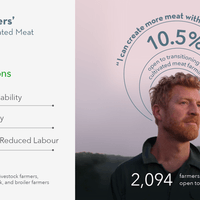
Producing food with cellular agriculture technology will offer a complementary income stream, especially for the growing number of farmers already exploring diversification of their businesses with new technologies. Working with RESPECTfarms is not about replacing livestock, but about adding a future-proof, resilient option to the mix. A growing number of EU farmers are leading this shift as early adopters. We found that already ~11% of Dutch farmers are open to produce meat in this way.


